

DigiThat journal · South Australia
Ideas worth putting to work.SA Success — Better business in South Australia

Good businesses deserve more than good intentions.
Practical strategies for South Australian owners: earn trust, make buying easier and turn attention into worthwhile work.
Find your next useful moveA better starting point
Find the friction.
Then fix the right thing.
Before spending more to attract people, look at what happens when they arrive. Can they understand the offer, trust the business and take the next step? A stronger website is one part of that system. The offer, response and delivery have to work together.
Pick the weakest step below. Give it an owner, make one change and check what happened. That is a more useful growth habit than trying everything at once.
Make the offer clear
Be easy to choose.
A customer should quickly understand who you help, what you do and what happens next. Specific language gives people something to evaluate. “Quality solutions” gives them another question.
Choose one priority customer and one important job they need done. Put the outcome first, explain the scope and show the next step. Pricing can be a clear range, a starting point with conditions, or an honest explanation of how a quote is prepared.
Ask three people who resemble your customers to read your opening message. Can they explain the offer back to you, without help?
Watch: the relevance of enquiries and the questions people still need to ask.
Make confidence visible
Show the substance.
Trust grows when a business makes itself understandable. Real people, relevant work, accurate reviews and clear expectations help a customer judge whether you are a good fit.
- People: who is responsible, and how to reach them.
- Work: what was delivered, for whom and under what conditions.
- Process: scope, timing, responsibilities and what is included.
- Proof: permissioned reviews and outcomes you can substantiate.
Replace one vague claim with a specific piece of evidence. Get permission before publishing customer material.
Watch: repeated objections and the reasons suitable prospects hesitate.
Business is personal
Make every interaction
earn the next one.
Helpful advice, a well-made product and a promise kept give customers a reason to return. Your digital experience should make that same care visible.


Connect attention to action
A visit is a beginning.
Build the next step.
Social posts, search results and recommendations create interest. Match each promise to a relevant page, make the action obvious and test the whole enquiry journey on a phone—including whether the message actually arrives.
Discover
A useful post or recommendation
Understand
A page that answers the real questions
Enquire
A clear action and working contact route
Decide
A relevant response and agreed next step
Try this week: follow your most important social link as a new customer would. Remove one unnecessary step and test delivery.
Watch: qualified enquiries per relevant visit, then enquiries that become worthwhile work.
Make the numbers tangible
What could one better step change?
Explore a conversion scenario using the same number of visits. The starting figures are an illustration, not a benchmark, forecast or DigiThat result.
Use a consistent period and definition of “enquiry”. A higher rate only helps if the enquiries are relevant and the work is worth doing.
Respect the enquiry
Good follow-through
is good business.
A form submission is a person asking for help. Give every enquiry a named owner and a next action. State a response time the team can actually meet; an automatic acknowledgement is useful, but it is not a substantive reply.
Make the response specific. Confirm the need, resolve the main uncertainty and agree on a next step. Record why an opportunity stalls or is lost. That feedback can improve the offer, the website and the work you choose.
Review the last ten enquiries. Is each one assigned, answered and clearly open, won or closed?
Watch: time to a useful reply, opportunities without a next action and reasons for lost work.
A simple enquiry discipline
- 01
Receive
Confirm delivery. Assign a person.
- 02
Understand
Clarify fit, scope and timing.
- 03
Agree
Set the next action and a date.
- 04
Learn
Record the outcome and the reason.

Put technology to useful work
Give AI a job.
Keep a person accountable.
Start with a repeated task that has a clear input and a checkable output: organising approved notes, drafting from a brief or summarising non-sensitive material. Define what a good result looks like before choosing a tool.
Use appropriate data controls. Keep confidential information out of tools that have not been approved for it. A person should verify facts, tone and consequences before anything reaches a customer.
Pilot one low-risk task with sample material. Count the time spent checking and correcting as well as the time spent generating.
Watch: net time saved, error rate and whether the team can reliably repeat the result.
A practical human checkpoint
Draft. Sort. Summarise.
Work from an agreed brief and approved material.
Accuracy · privacy · suitability
Approve. Send. Commit.
Keep responsibility with someone who understands the business.
Net time saved = old effort − new effort − review and rework.
Grow work that is worth doing
More activity.
Or a better business?
More leads are not automatically better. Look at customer fit, delivery capacity and what remains after the cost of doing the work. Include the owner's time: an offer that only works with unpaid overtime needs attention.
Before discounting, check whether the scope, value and buying process are clear. Before buying more traffic, check whether you can serve the demand well. Make the next investment against a defined constraint and a measurable commercial objective.
Review three recent jobs: revenue, direct costs, hours, rework and payment timing. Use actual records; leave missing figures unknown.
Watch: contribution after direct costs, delivery hours, rework and cash collected—not just reach or revenue.
The owner's weekly scorecard
Choose a few measures you can trust.
Review the trend and the reason.

A local perspective
Distinctive places.
Distinctive businesses.
From Adelaide to the Barossa and Clare Valley, a business can draw on a real sense of place. Show what is particular to yours: the people, the craft, the setting and the way you work.
Then make those strengths useful to a customer. Local character opens the conversation. Clear information helps them take the next step.


Make it practical
One month.
One meaningful improvement.
A focused plan for a small team. Choose a change small enough to complete and important enough to measure.
- Week 01
Listen & locate
Review enquiries and speak with customers. Pick one recurring obstacle. Record the starting position.
- Week 02
Make the change
Rewrite the offer, strengthen the proof or remove a difficult step. Assign an owner and finish it.
- Week 03
Test the journey
Try it on a phone. Check the form, acknowledgement, useful response and next action.
- Week 04
Review & decide
Compare like-for-like periods. Note sample size and other changes. Keep, refine or stop; avoid claiming a win from a handful of visits.
A clearer next step
Make your website
work with your business.
DigiThat helps turn a good business into a clearer online experience. Have a chat with DigiThat about the sticking point. We’ll look at what a useful improvement could involve.
Chat with DigiThat Start with a website checkSources & further reading
Original practical guidance from DigiThat, informed by Australian Government resources. General business information; the right decision depends on your business and circumstances.
About the artwork
The regional images are architectural interpretations, not documentary photographs or evidence of a client relationship. Pictured venues do not endorse this guidance.
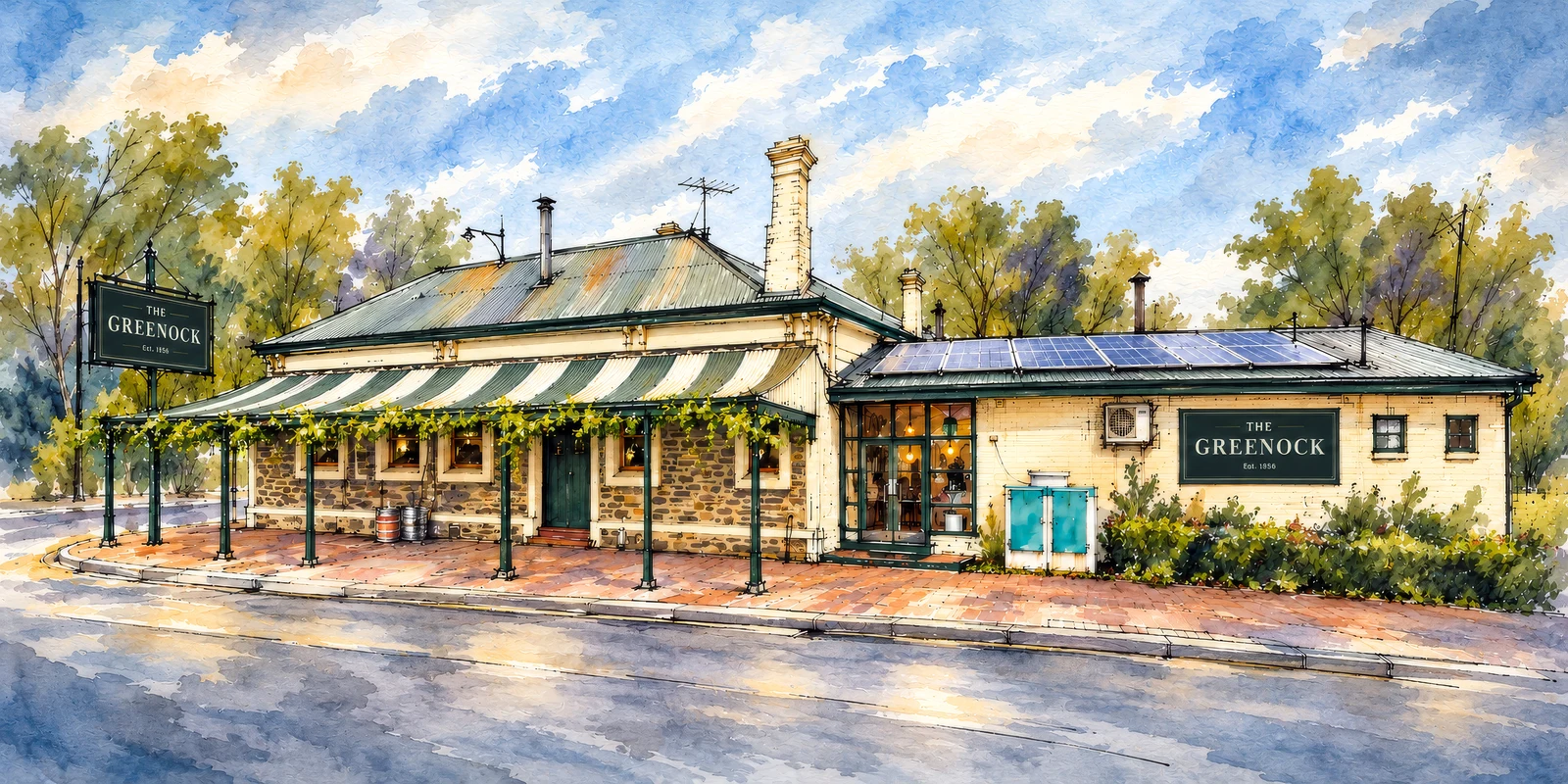
Adelaide: AI-assisted watercolour created from Robin Custance’s supplied River Torrens photograph. Barossa: supplied Greenock Hotel artwork.
Clare and Barossa: AI-assisted watercolours composed using regional photographs supplied by Robin as visual references. These are interpretive scenes with new compositions, lighting and selected details, rather than records of an exact viewpoint. The Barossa palm avenue also draws inspiration from Robin’s festival artwork.
The market and bakery scenes feature fictional people and premises, inspired by the work of South Australian traders. Visual research included SALIFE’s September 2026 market feature (photography: Ben Macmahon) and the Adelaide Central Market’s trader profiles. They do not depict an actual customer interaction or the new market expansion.
SA Success is a DigiThat publication for South Australian business owners. Reviewed November 2026.